
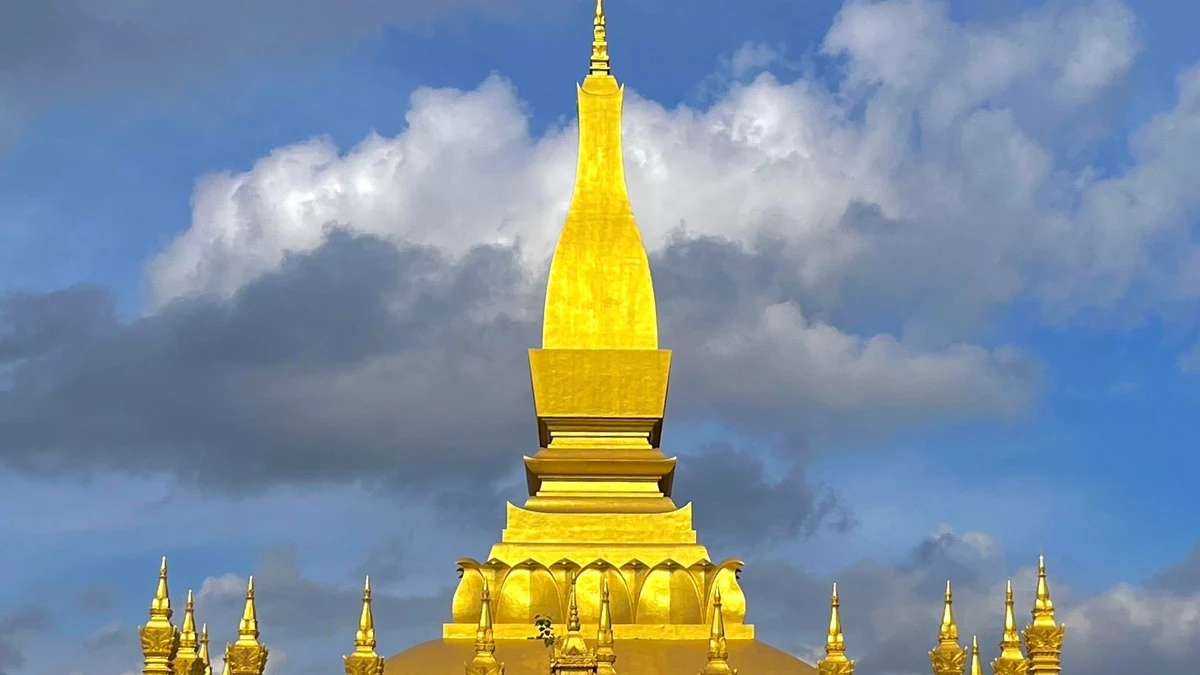

VIENTIANE, Laos — Rising above the quiet, tree-lined boulevards of the Lao capital, the burnished gold spire of Pha That Luang (the “Great Sacred Stupa”) does not just catch the harsh Indochinese sun—it anchors an entire nation’s identity.
In a Southeast Asian capital devoid of frantic high-rises and choking expressway gridlock, Pha That Luang commands a vast, contemplative clearing. It is both a sacred national shrine—emblazoned on the official seal of the Lao People’s Democratic Republic and every Lao Kip banknote—and an active center of Buddhist pilgrimage.
Yet, despite its monumental status, many travelers leave That Luang with mixed impressions. Some wander through the scorching midday courtyard in twenty minutes, wondering if there is more to see beyond the central stupa; others are caught off guard by strict dress regulations or persistent tuk-tuk markups outside the gates.
Here is the unfiltered, ground-level field guide to experiencing Pha That Luang, its neighboring monasteries, and Vientiane’s sacred heritage with the depth and respect it deserves.
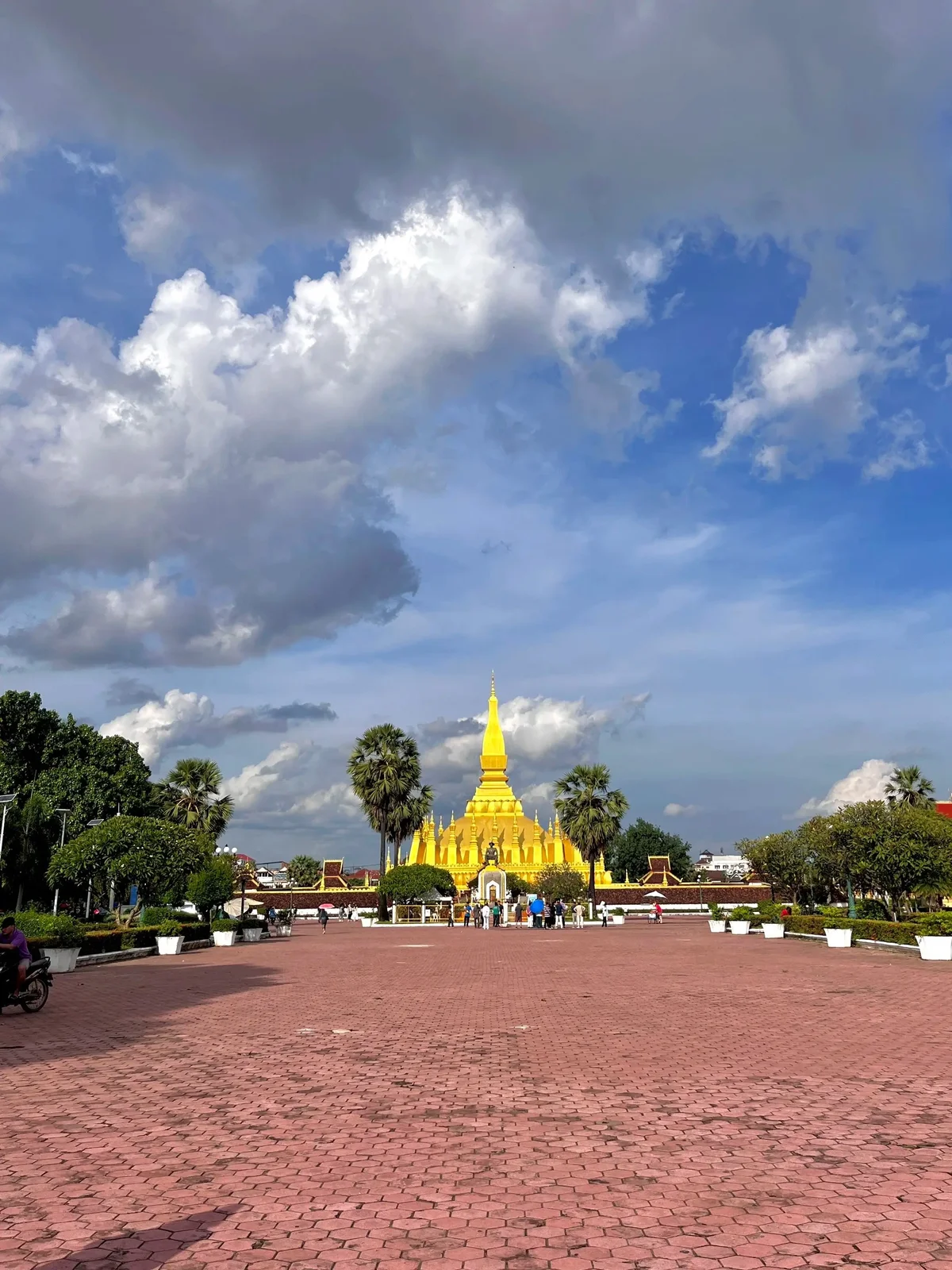
The immense red-brick esplanade of Pha That Luang, framed by tropical palms and the wide open sky of central Vientiane.
1. The Living Relic of Lan Xang: A Tumultuous History
According to local Theravada chronicle and folklore, the earliest sanctum here was established around the 3rd century BC, when Mauryan Buddhist emissaries dispatched by Emperor Ashoka enshrined a sacred relic—the holy breastbone of the Gautama Buddha.
Centuries later, the site served as an unadorned Khmer outpost with an eleventh-century stone temple, ruins of which were unearthed during French archaeological restorations.
The stupa we witness today, however, was born from a pivotal geopolitical pivot in 1566:
- King Setthathirath’s Vision: Facing relentless military pressure from the rising Burmese Toungoo Empire, King Setthathirath relocated the royal capital of the Lan Xang Kingdom (“Land of a Million Elephants”) south from Luang Prabang to Vientiane. To sanctify the new capital, he commissioned a colossal golden chedi atop the ancient ruins.
- Sack, Ruin, and Reconstruction: In 1828, during the brutal suppression of the Lao rebellion, the invading Siamese army razed Vientiane to ash, stripping That Luang of its heavy gold leaf and smashing its outer galleries in search of concealed treasure. For nearly seven decades, the monument lay strangled by tropical jungle until the French colonial administration—led by artist Louis Delaporte and the École française d’Extrême-Orient (EFEO)—meticulously reconstructed the complex to its original 16th-century proportions in the 1930s.
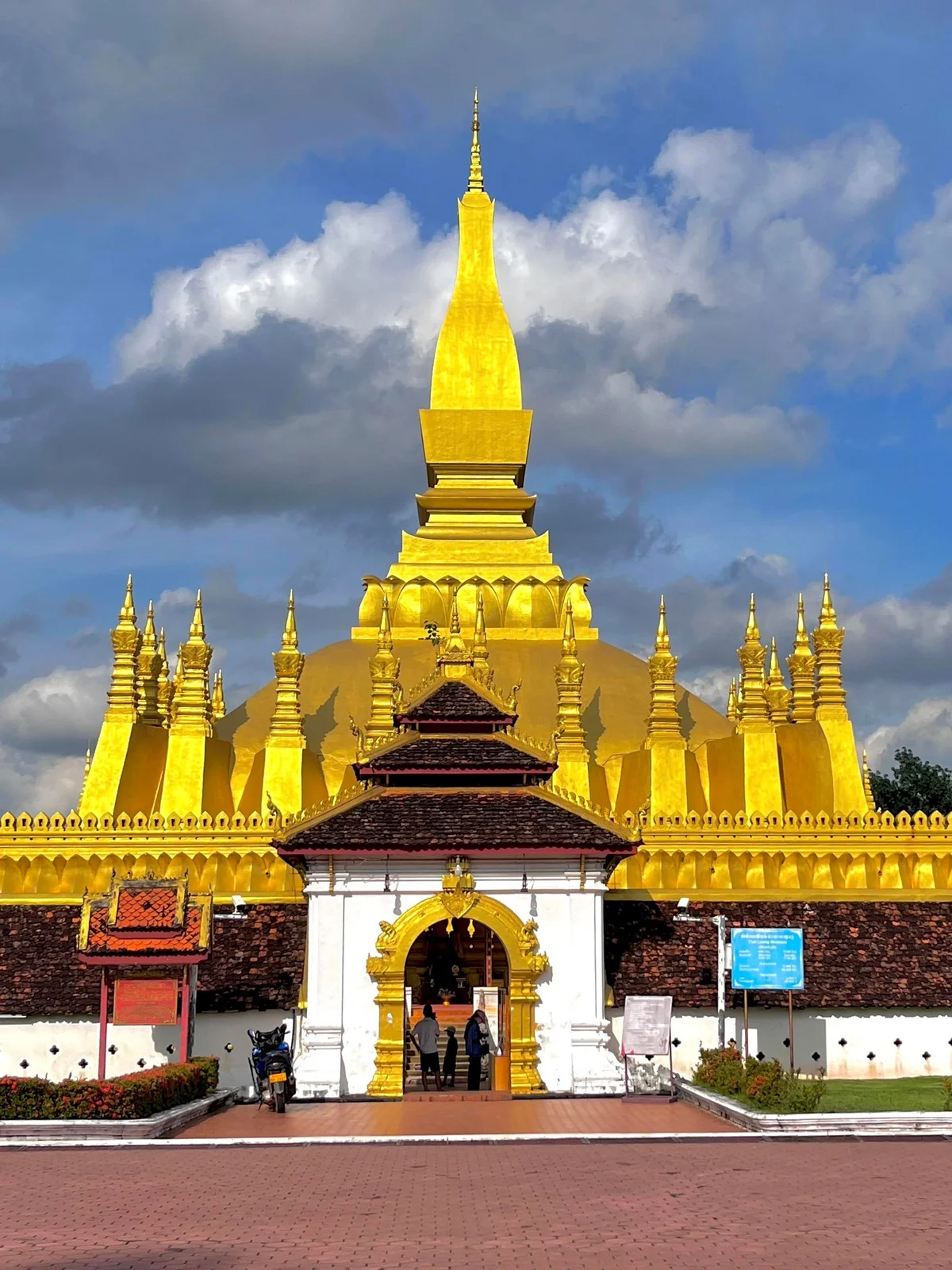
The vaulted entrance pavilion leading into the inner cloister, framed by the 44-meter central golden spire.
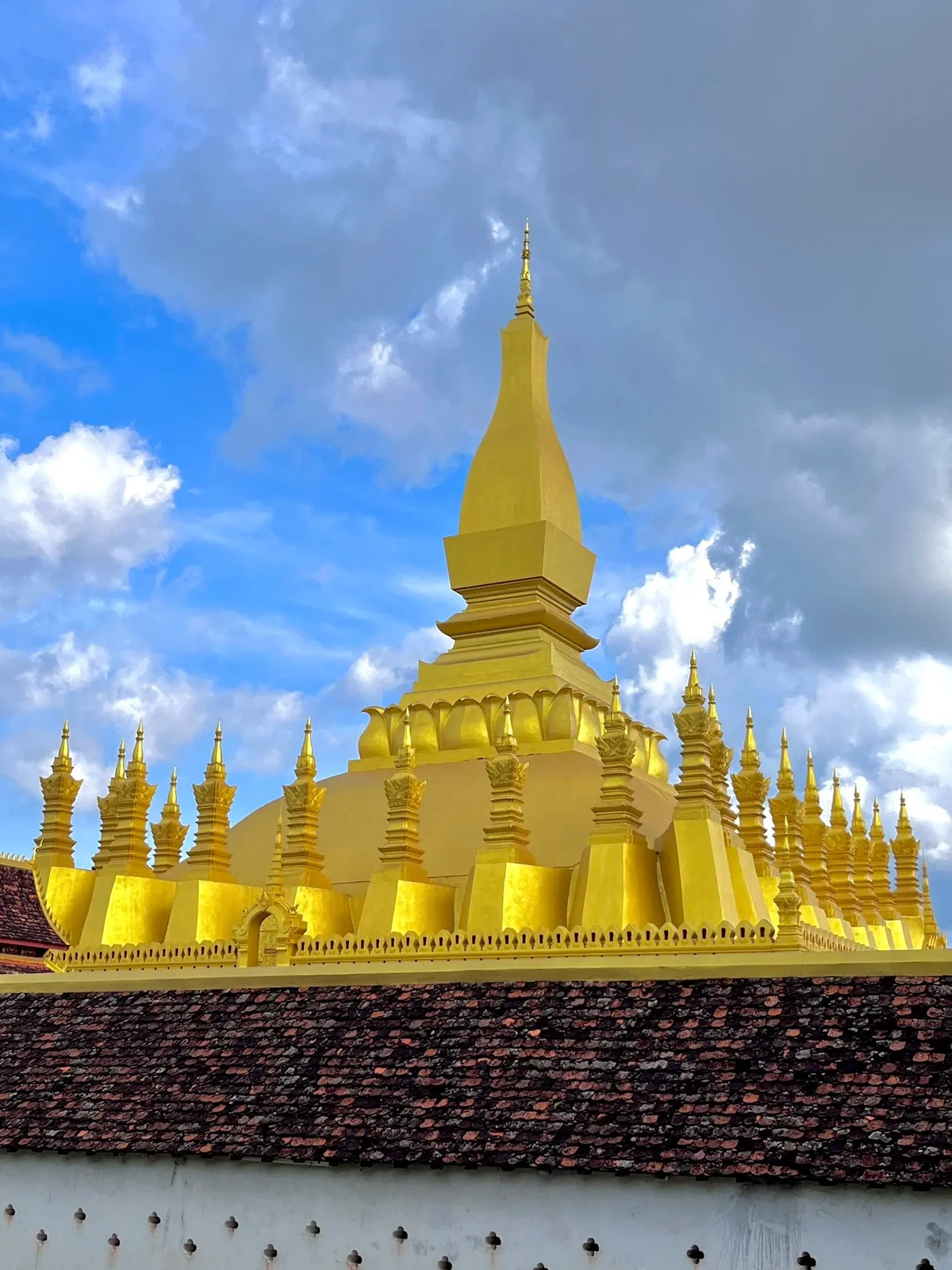
Detail of the elongated four-sided lotus bud spire (Prang), flanked by 30 gilded pinnacles representing Buddhist perfections.
2. Buddhist Cosmology in Gold: Architectural Breakdown
Pha That Luang is not a hollow temple you step inside; it is a solid stupa designed for pradaksina—the sacred Buddhist ritual of circumambulation in a clockwise direction.
The structure is a physical manifestation of Buddhist cosmology, rising in three distinct tiers from the earthly realm of human passions to the transcendent pinnacle of enlightenment:
- The Terrestrial Base (Lowest Tier): A massive square terrace measuring 69 meters on each side, supported by 323 carved stone sema boundary stones and fronted by four vaulted arched pavilions (Haw Trai) where devotees present marigold garlands, incense, and lotus buds.
- The Realm of Perfections (Middle Tier): The second level is surrounded by 30 golden miniature pinnacles (That Noy), each containing an inscribed gold leaf detailing one of the thirty Paramitas (the spiritual virtues and moral perfections required to attain Buddhahood).
- The Spiritual Apex (Third Tier): A square base that gently transitions into an elegant, tapering four-sided pyramid resembling an elongated lotus bud (Dok Bua), culminating in a slender gilded spire that pierces the sky at 44 meters (144 feet).
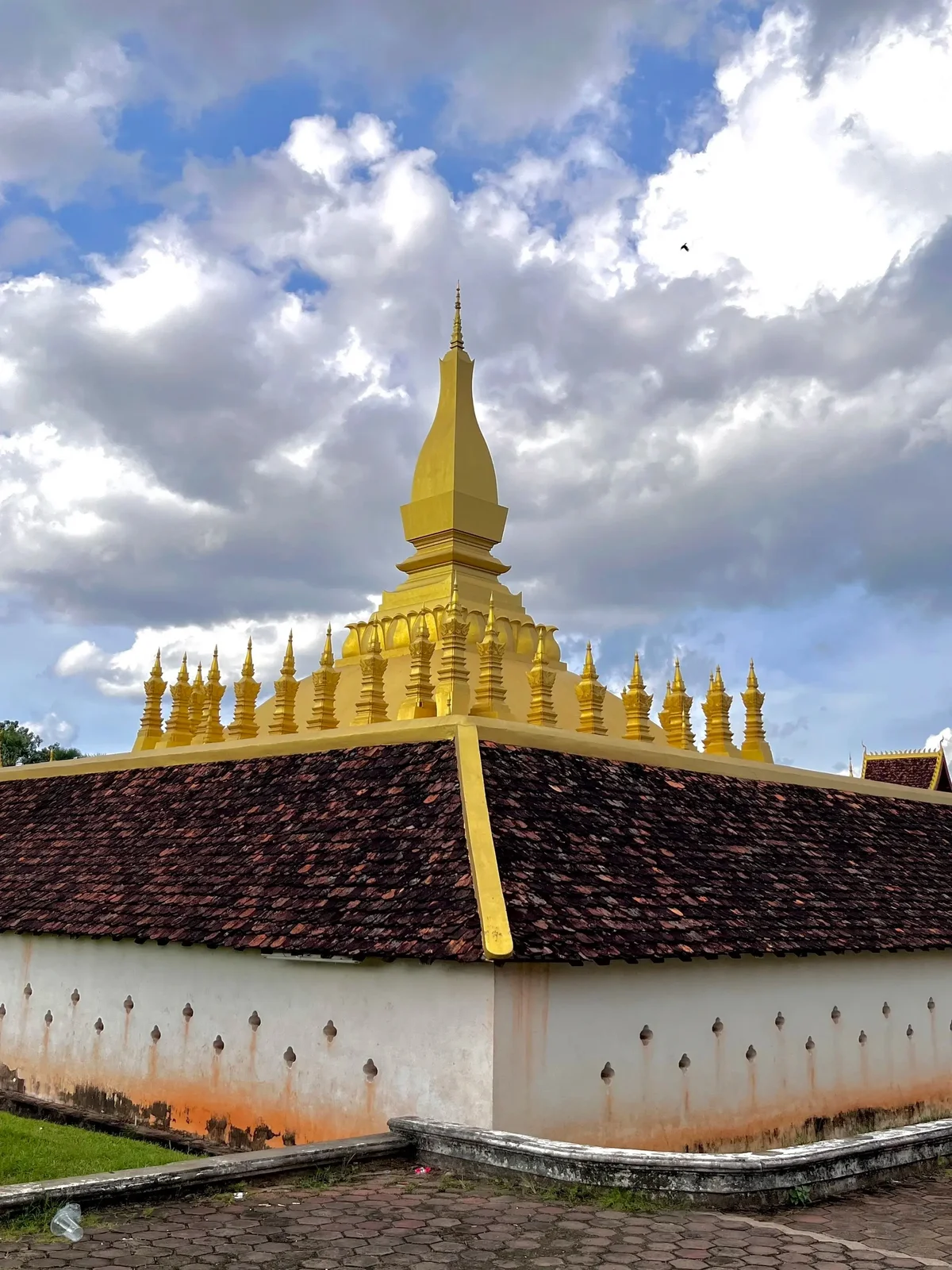
The defensive whitewashed perimeter wall (Khong Khet) with terracotta-tiled roofs, shielding the golden sanctuary within.
Walking the Shaded Cloister
Surrounding the main chedi is a continuous square cloister with dark-tiled eaves and slotted arrow loops. Here, out of the blistering sun, travelers can inspect centuries of accumulated Buddhist art:
- Ancient, weathered sandstone statues salvaged from the 1828 Siamese pillage.
- Sculptures depicting the Buddha in the Bhumisparsha Mudra (calling the earth to witness) and Abhaya Mudra (warding off fear).
- The evocative Parileyyaka Forest relief: an intimate Buddhist narrative where an elephant offers water and a wild monkey presents a honeycomb to the Gautama Buddha while meditating in isolation.
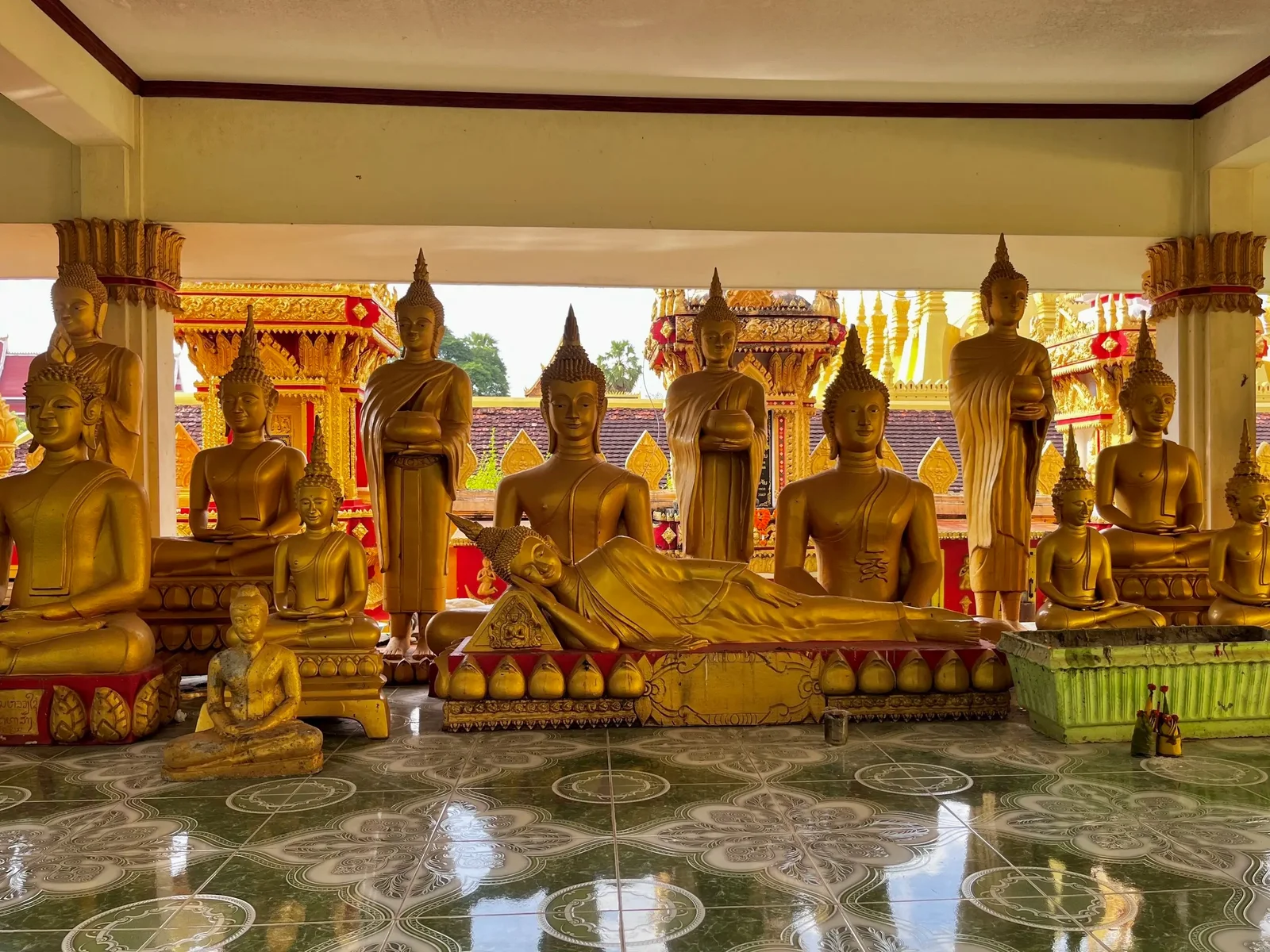
Rows of gilded Buddha effigies resting upon patterned tiles within the tranquil perimeter cloister.
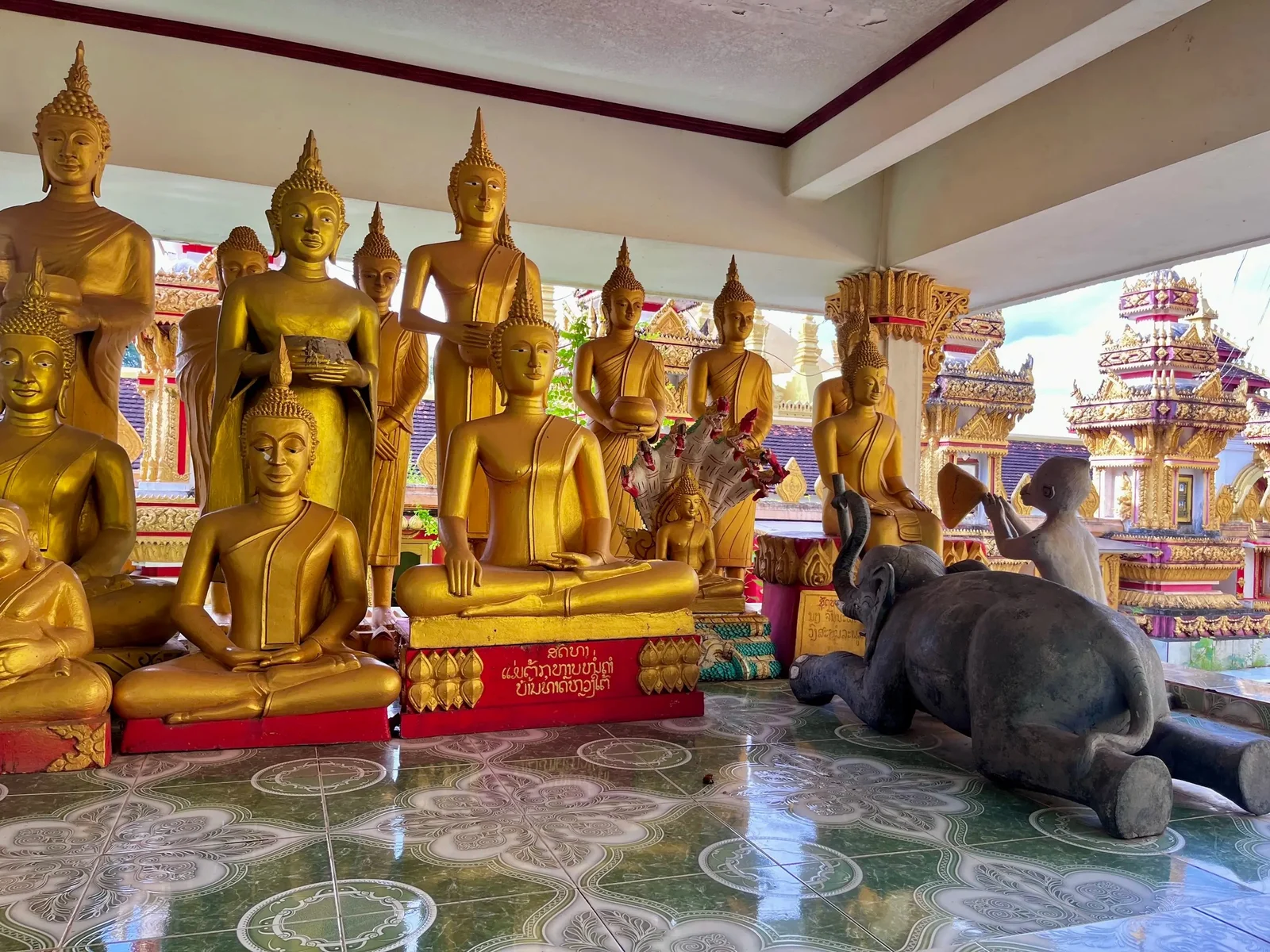
The Parileyyaka forest scene: animal attendants offering forest nourishment to the enlightened master.
3. Wat That Luang Neua: The Seat of Lao Monastic Power
Most tourists buy a ticket, photograph the central golden stupa, and immediately walk out to find a taxi. In doing so, they miss the two most magnificent active monasteries in Vientiane located just outside the stupa walls.
Directly to the north sits Wat That Luang Neua (Northern That Luang Temple), the official ecclesiastical residence of the Supreme Patriarch (Sangharaja) of Lao Buddhism.
The temple’s central sim (ordination hall) is an absolute masterpiece of classic Lan Xang architectural proportion:
- The Sim Facade: Soaring whitewashed pillars frame deeply recessed, gold-encrusted pediments featuring intricate depictions of the Buddha preaching to celestial deities (Devas).
- Naga Staircases: Two emerald-and-gold multi-headed mythical water serpents (Phaya Naga) flank the marble entrance stairway, their scales shimmering in the afternoon light.
- Gilded Teakwood Doors: Hand-carved solid timber portals lacquered in vermilion and coated in gold leaf, depicting armed guardian spirits (Dvarapala) riding mythical beasts to banish impure thoughts from entering the sanctuary.
- Phra Lak Phra Ram Murals: Brightly pigmented exterior bas-reliefs bring the Lao adaptation of the Indian Ramayana epic to life, portraying dynamic battles between monkey general Hanuman and terrifying demon warlords (Asuras).
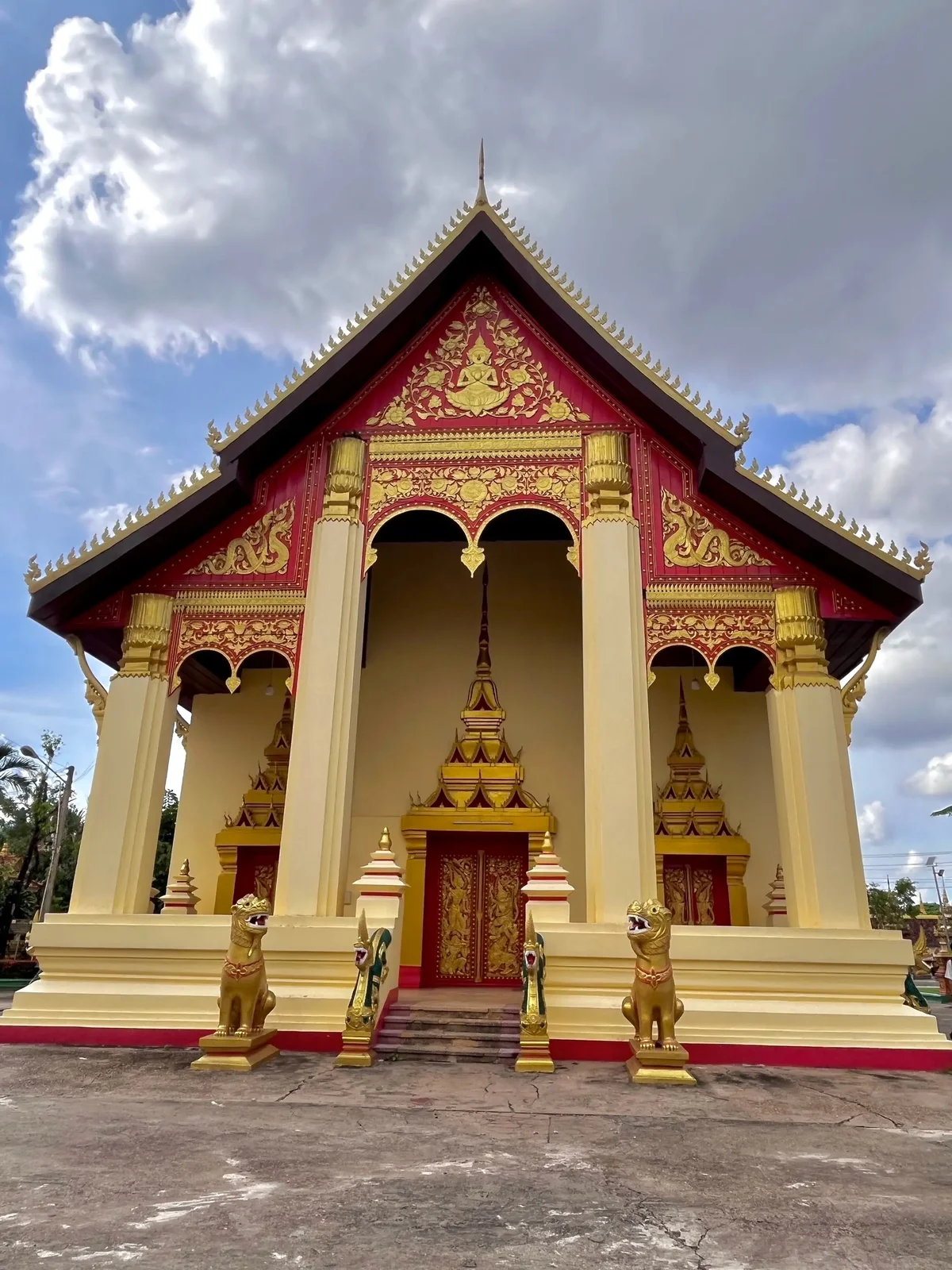
The front portico of Wat That Luang Neua, guarded by golden Singha lions and multi-tiered timber pediments.
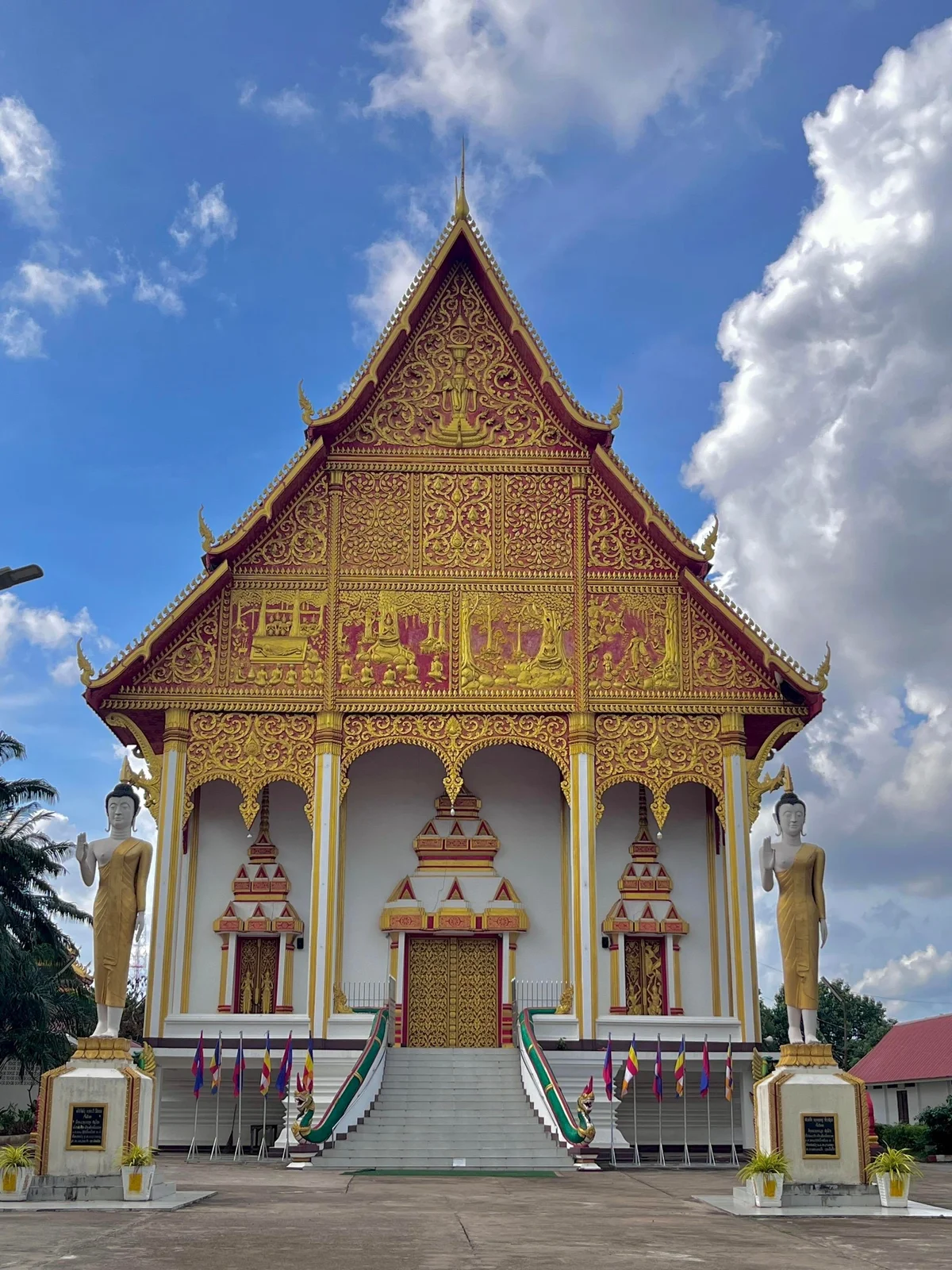
The ceremonial stairway with white-robed standing Buddhas extending protective blessing mudras.
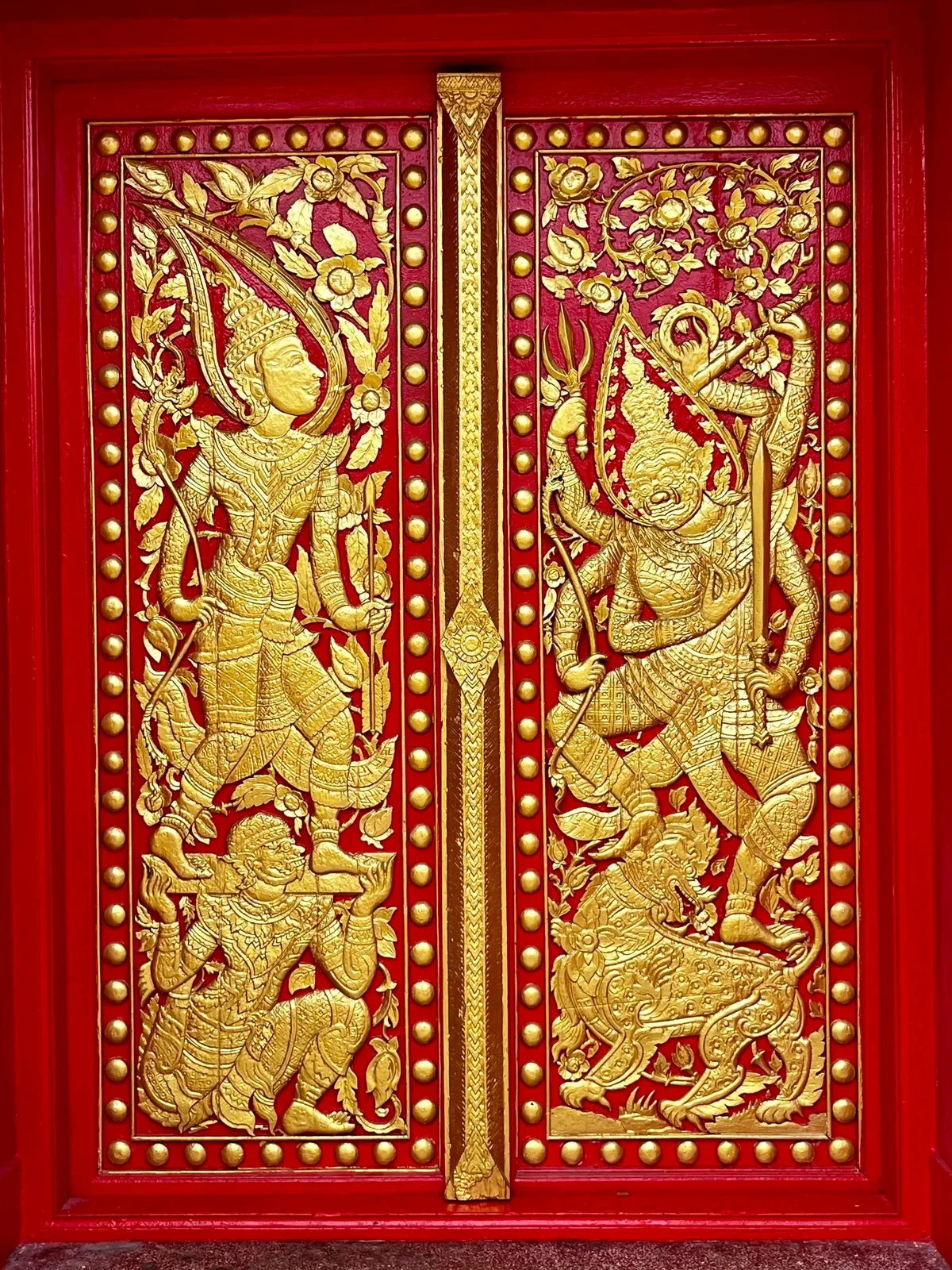
Intricate gilded lacquer temple doors with multi-armed celestial guardians.
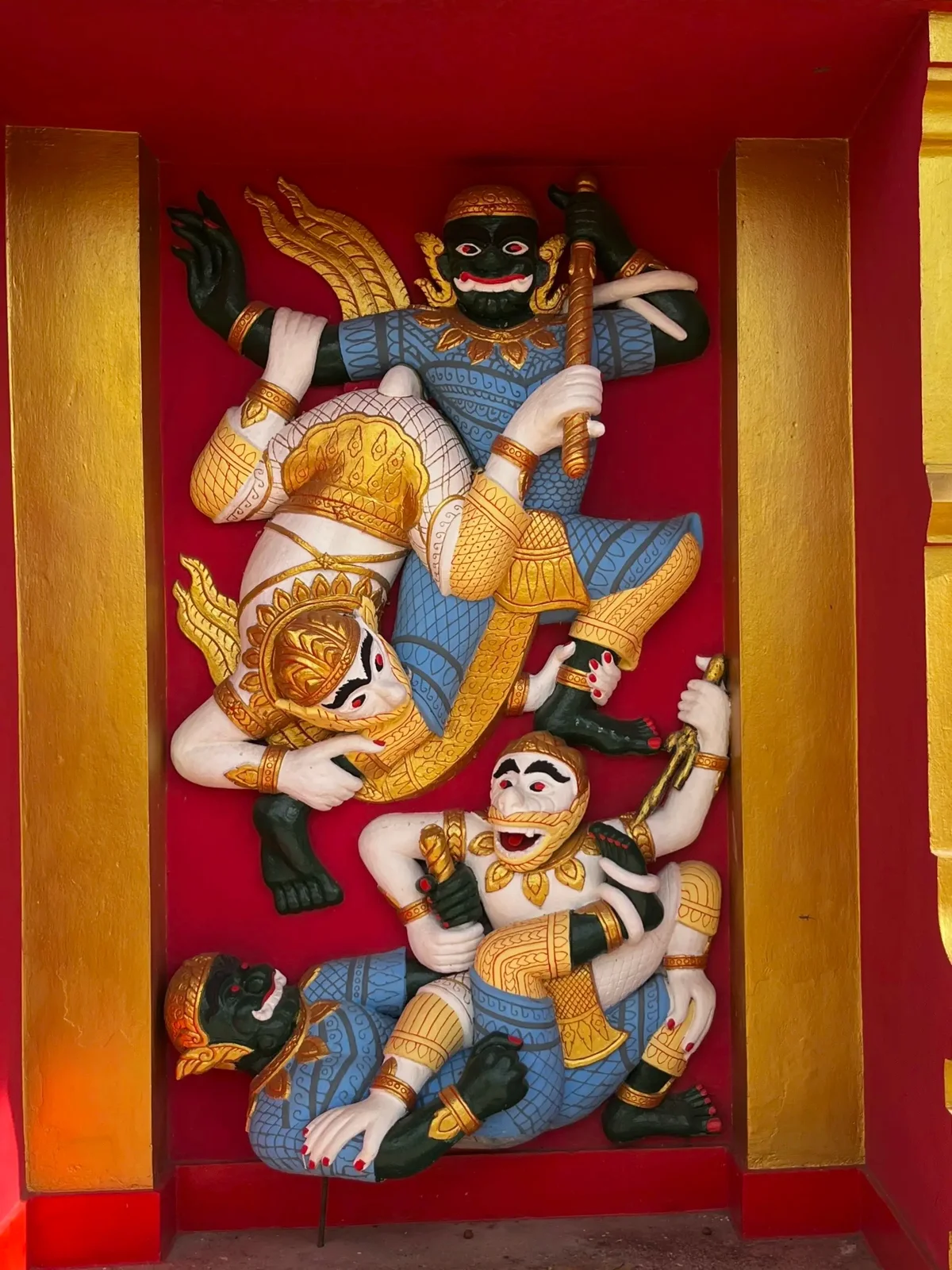
Vivid Phra Lak Phra Ram relief showing monkey heroes grappling with Asuras.
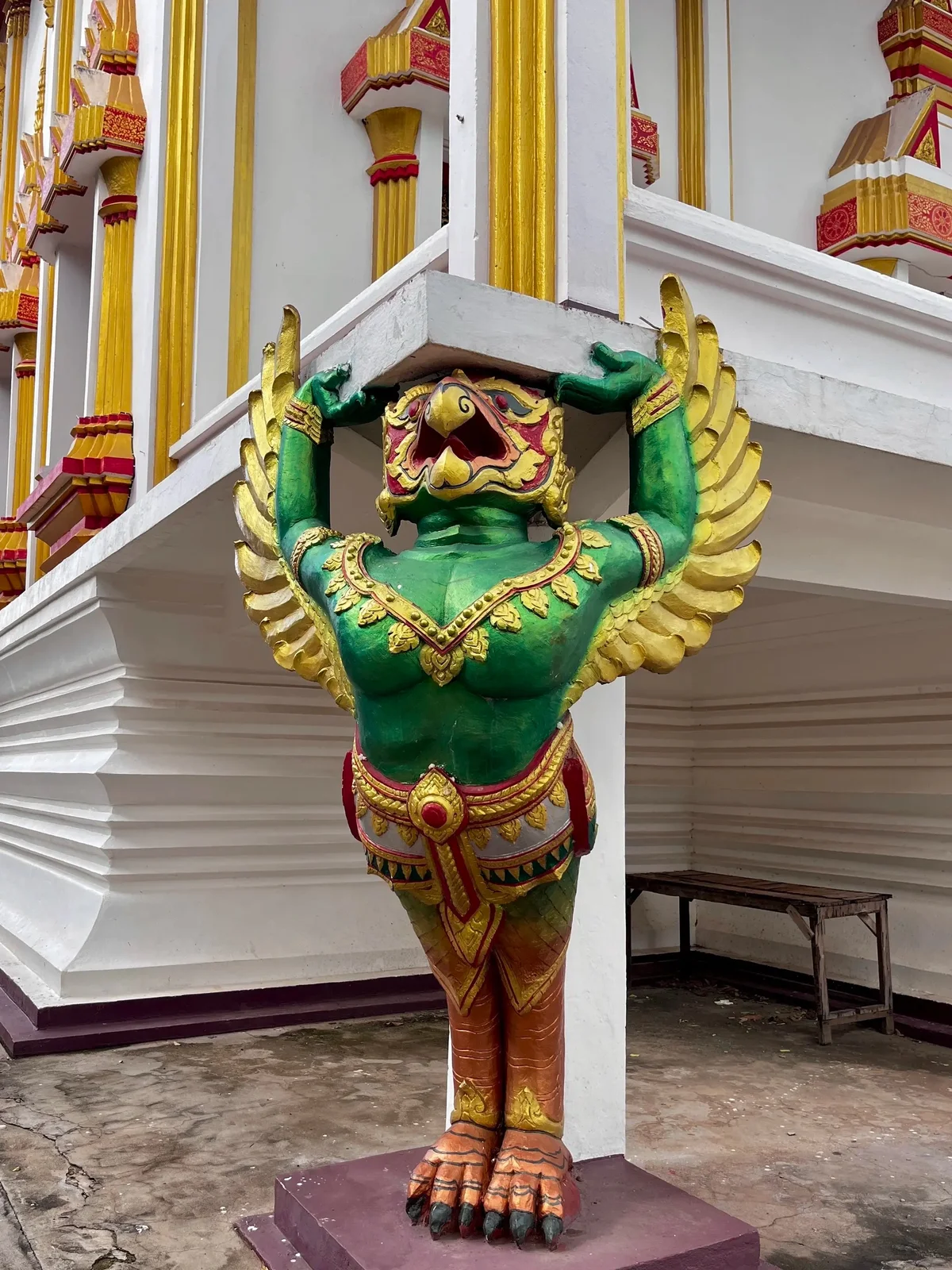
Vibrant emerald-and-gold Garuda caryatid bearing the weight of the temple roof eaves.
4. Wat That Luang Tai & The Giant Golden Reclining Buddha
Across the southern square sits Wat That Luang Tai (Southern That Luang Temple). While smaller than its northern sibling, it draws pilgrims from across the Buddhist world for one breathtaking sight: the monumental Open-Air Reclining Buddha (Phra Bouddha Saiyat).
Stretching gracefully across a raised crimson platform in the courtyard, this colossal golden effigy depicts the Buddha entering Parinirvana—the final release from the cycle of rebirth (samsara):
- The Pose: The Buddha lies peacefully on his right side, head supported upon his palm and cushioned by a heavily decorated traditional triangular Lao bolster (Mon Sam Liam).
- Serene Contemplation: Unlike representations in Thailand or Sri Lanka that can appear rigid, this Lao sculpture is renowned for its gentle, elongated facial lines and serene half-smile, reflecting the enduring peace of enlightenment.
- The Naga Frame: Looking through the portico of the neighboring hall, visitors can capture a breathtaking photographic perspective: twin green-crested Nagas framing the colossal golden figure resting beneath the rolling monsoon clouds.
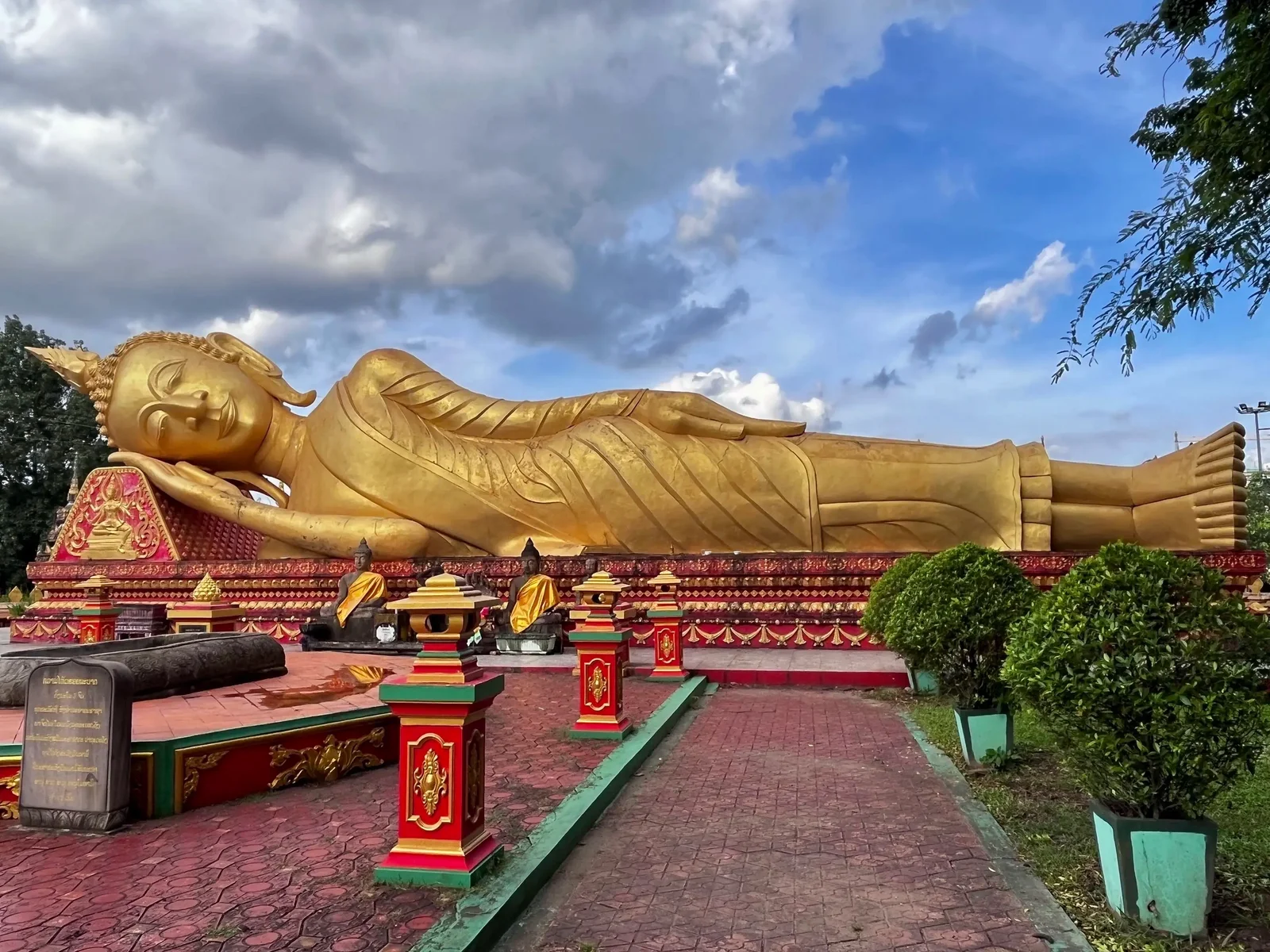
The colossal Golden Reclining Buddha at Wat That Luang Tai, measuring over 30 meters in length and gleaming beneath the Vientiane afternoon sky.
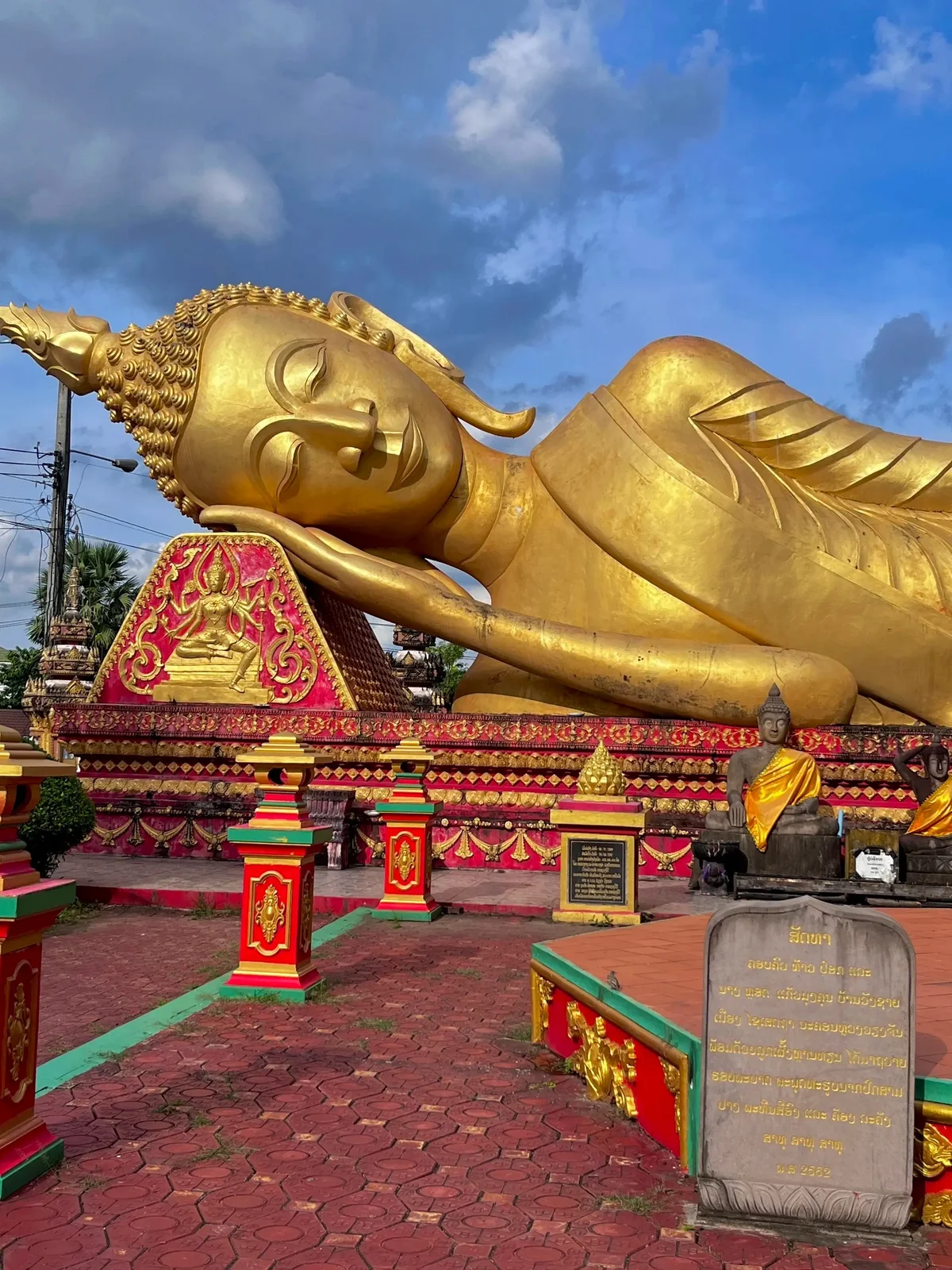
Close-up detail of the gilded face, curved ushnisha flame, and hand-embroidered bolster motif.
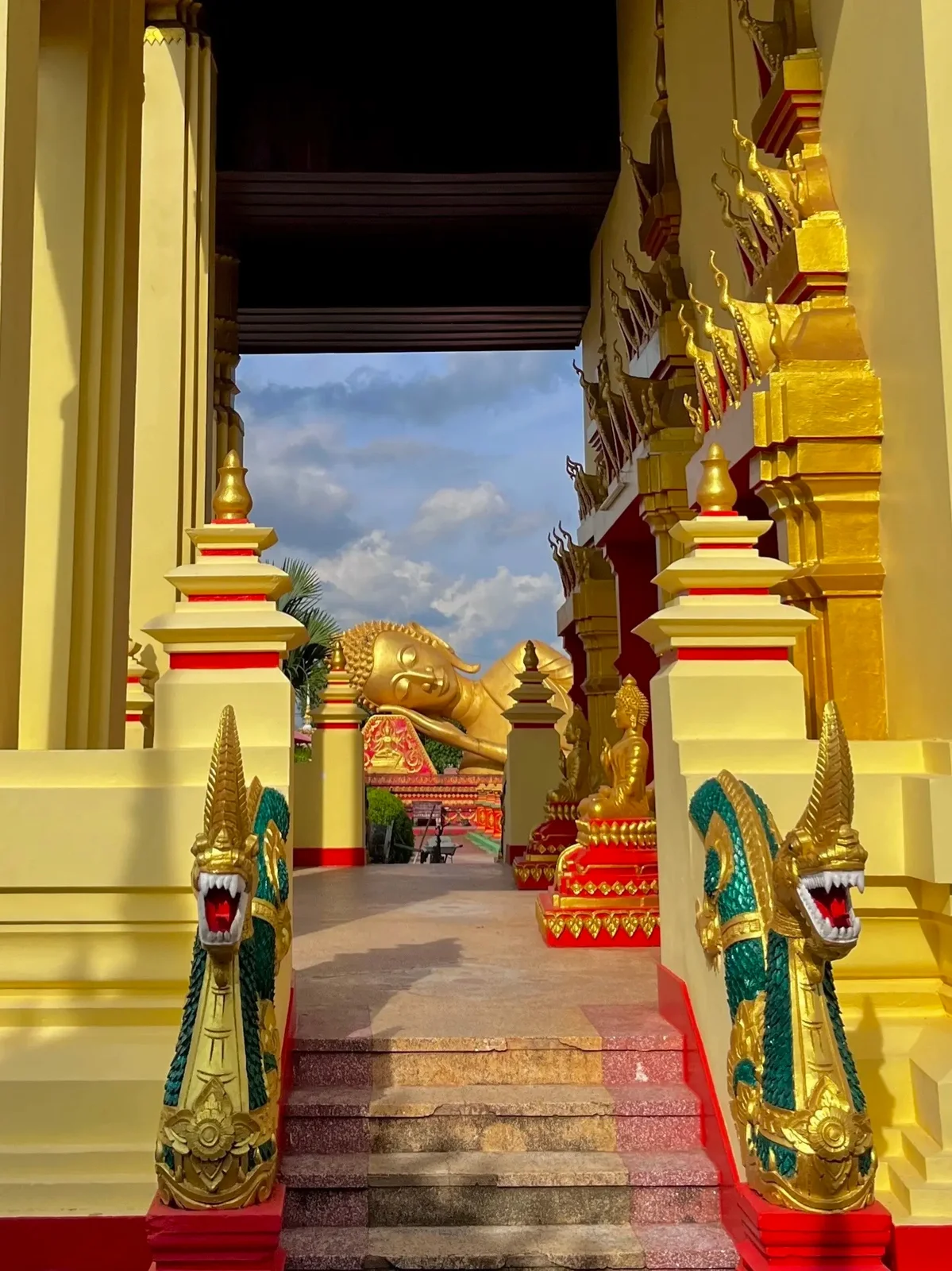
An architectural frame: twin emerald-and-gold Nagas framing the golden giant from the temple steps.
5. Beyond the Stupa: The Surreal Concrete of Buddha Park (Xieng Khuan)
A trip to Vientiane’s sacred sites is incomplete without venturing 25 kilometers downstream along the muddy Mekong River to Xieng Khuan, universally known as Buddha Park.
Built in 1958 by the enigmatic mystic and monk-sculptor Luang Pu Bunleua Sulilat, the park is a bizarre, mesmerizing open-air sculpture garden where Orthodox Theravada Buddhism merges seamlessly with ancient Hindu mythology:
- Sulilat was not an academic artist; he believed in synthesizing the spiritual cosmologies of Buddhism and Hinduism into tangible folk art. He directed untrained laborers to pour raw, unpolished reinforced concrete directly into hand-hewn molds.
- Over 200 statues populate the riverside meadow: twelve-armed Shiva figures, elephant gods, four-headed Brahmas, dancing Apsaras, and a massive 40-meter concrete Reclining Buddha that looks like an ancient monolith forgotten by time.
- The Giant Pumpkin: Visitors can enter through the gaping mouth of a mythological demon head into a hollow, three-story concrete sphere representing Hell, Earth, and Heaven. Climb the winding stone staircase through the cramped central trunk to emerge atop the dome for a panoramic vista of the entire concrete pantheon and the Thai border across the water.
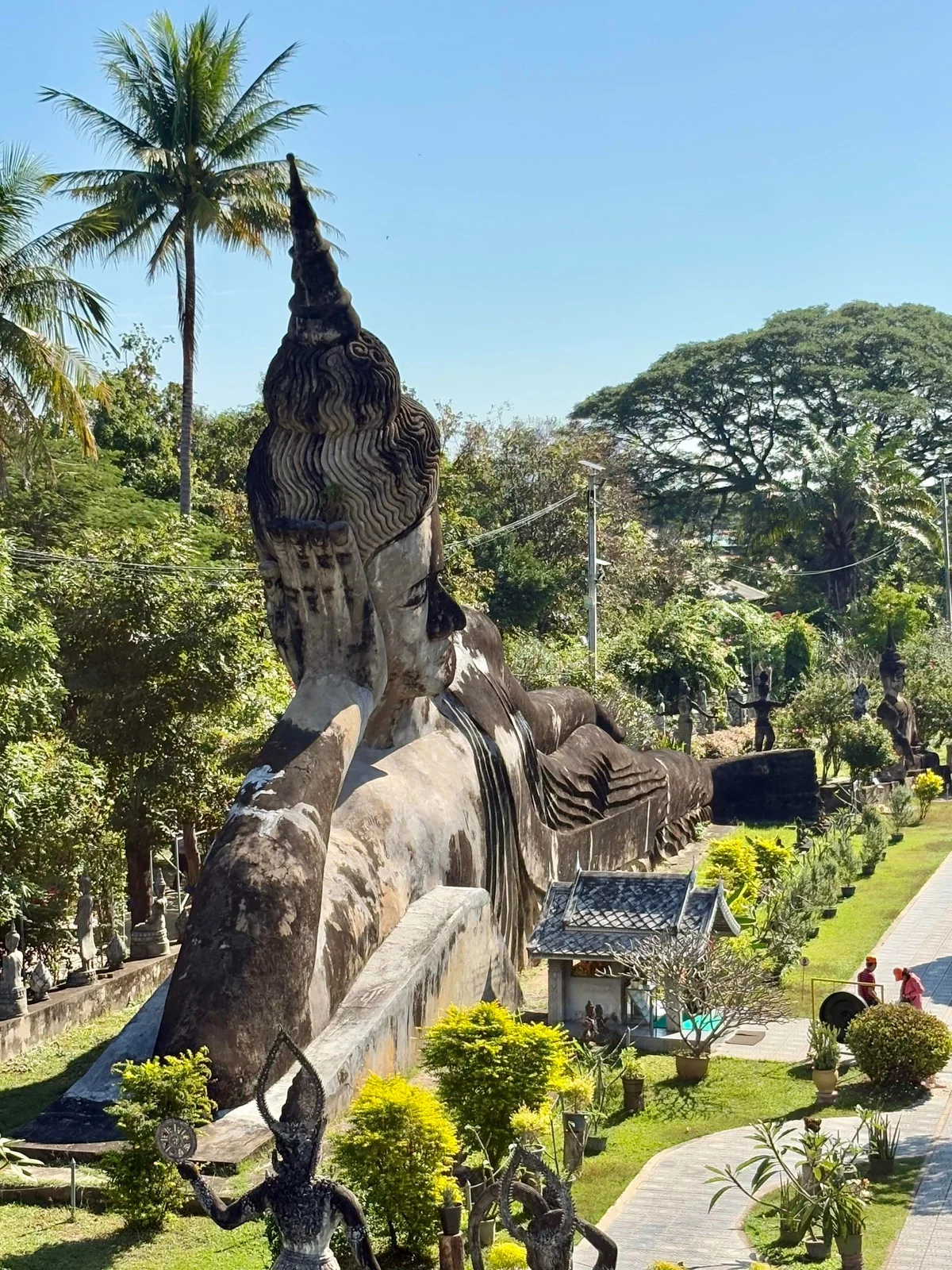
The massive 40-meter concrete Reclining Buddha at Xieng Khuan (Buddha Park), standing amid tropical palms by the Mekong.
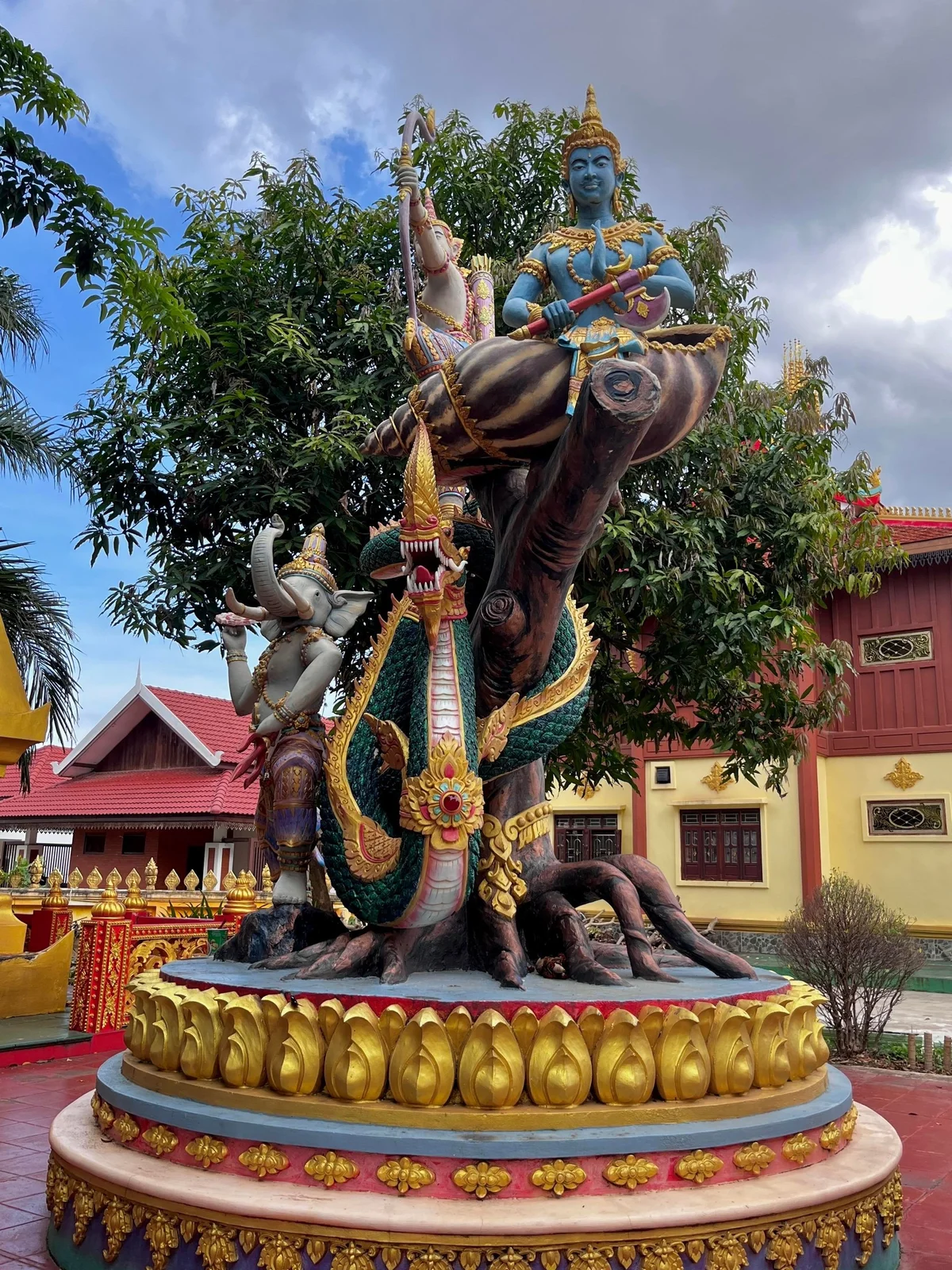
Sacred statuary outside the sim: Indra astride the celestial elephant Airavata, surrounded by coiled Naga spirits.
6. The Honest Traveler’s Field Manual
Visiting Pha That Luang requires navigating a few distinct local realities that standard travel brochures gloss over. Keep these essential tips in mind before setting out:
Avoid the Midday “Barefoot Stone Trap”
To enter the inner cloister of Pha That Luang, all visitors must remove their footwear. Between 11:00 AM and 2:30 PM, the unshaded stone slabs of the open courtyard absorb punishing tropical solar heat. Walking on them barefoot feels like walking across a hot frying pan, forcing tourists to dash between slivers of shade.
Best Strategy: Arrive right when the gates open at 8:00 AM to enjoy cool temperatures and soft morning light, or visit around 3:45 PM – 5:00 PM to watch the golden spire glow against the golden hour and twilight.
Dress Code & The Lao “Sinh” Requirement
This is Laos’ most sacred site; temple security enforces modesty strictly.
- Shoulders and knees must be fully covered. Sleeveless tank tops, plunging necklines, and short shorts are strictly prohibited for both men and women.
- Women in trousers or leggings: While long pants are technically accepted at many Thai temples, at Pha That Luang, female travelers wearing pants or knee-length dresses are frequently asked to wear a traditional Lao tubular wrap skirt (Sinh).
- Do not panic: you can rent a clean cotton sinh at the ticket kiosk for 10,000–20,000 Lao Kip ($0.50–$1.00 USD). Wrapping the patterned cloth around your waist is not just polite—it makes for infinitely more authentic travel portraits.
Getting Around: Tuk-Tuks vs. The LOCA App
- Outside the main esplanade, waiting three-wheeled tuk-tuks will invariably quote foreign travelers inflated flat rates of 150,000 to 200,000 Kip ($7–$10 USD) for a short 3 km ride back to the central riverfront.
- Use LOCA: Download the LOCA app (the Lao equivalent of Grab or Uber). It connects directly to your credit card, gives transparent metered fares, avoids haggling, and will call an air-conditioned car for less than half the price of a tuk-tuk.
- Alternatively, Vientiane’s flat, wide avenues make it one of the easiest cities in Asia to explore on a rented 50,000-Kip bicycle or an electric scooter.
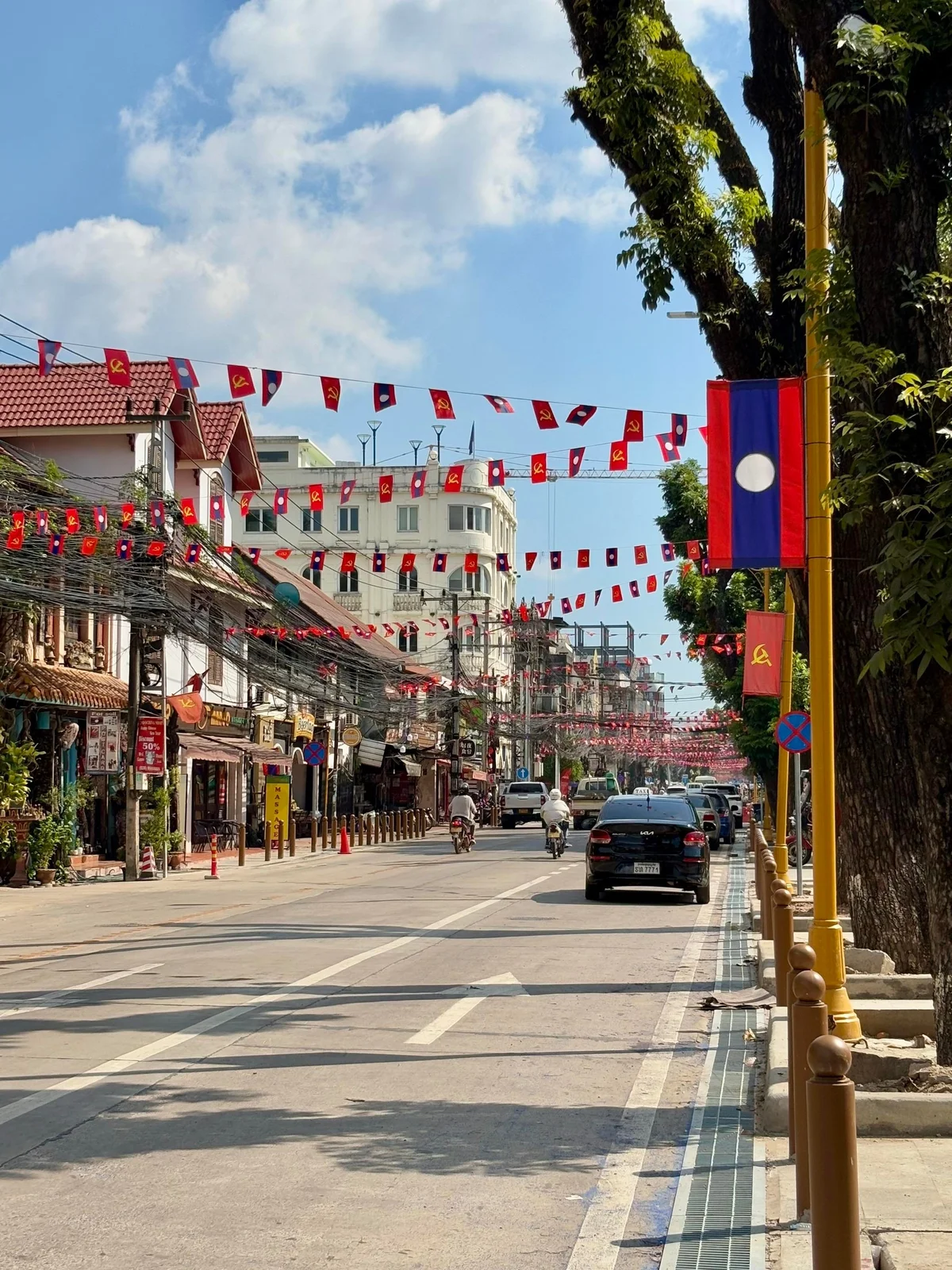
The peaceful, unhurried rhythm of central Vientiane: tree-shaded colonial boulevards draped in national and state banners.
Practical Visitor Details
- Opening Hours: Daily from 8:00 AM to 12:00 PM, and 1:00 PM to 5:00 PM (Note the midday lunch closure of the inner stupa ticket booth!).
- Entrance Fee: 30,000 Lao Kip (~$1.40 USD) per person for foreign travelers to enter the inner stupa grounds. Wat That Luang Neua and Wat That Luang Tai courtyards are free to enter (donations appreciated in the merit boxes).
- When to Catch the Magic: If your calendar allows, visit during the Boun That Luang Festival held over three days during the full moon of the twelfth lunar month (usually November). Over 100,000 pilgrims and thousands of saffron-robed monks from across Southeast Asia converge on the esplanade for dawn almsgiving (Tak Bat) and spellbinding candlelight circumambulations (Vien Thien).
The Verdict
Pha That Luang is not a site to be checked off in haste on an organized bus tour.
Take the time to walk beyond the central ticket barriers. Step inside the serene northern monastery to admire the woodcarvers’ craft, sit in the quiet shade of Wat That Luang Tai as incense wafts past the colossal sleeping Buddha, and feel the gentle, timeless cadence of a country that measures its wealth not in skyscrapers, but in peace of mind.